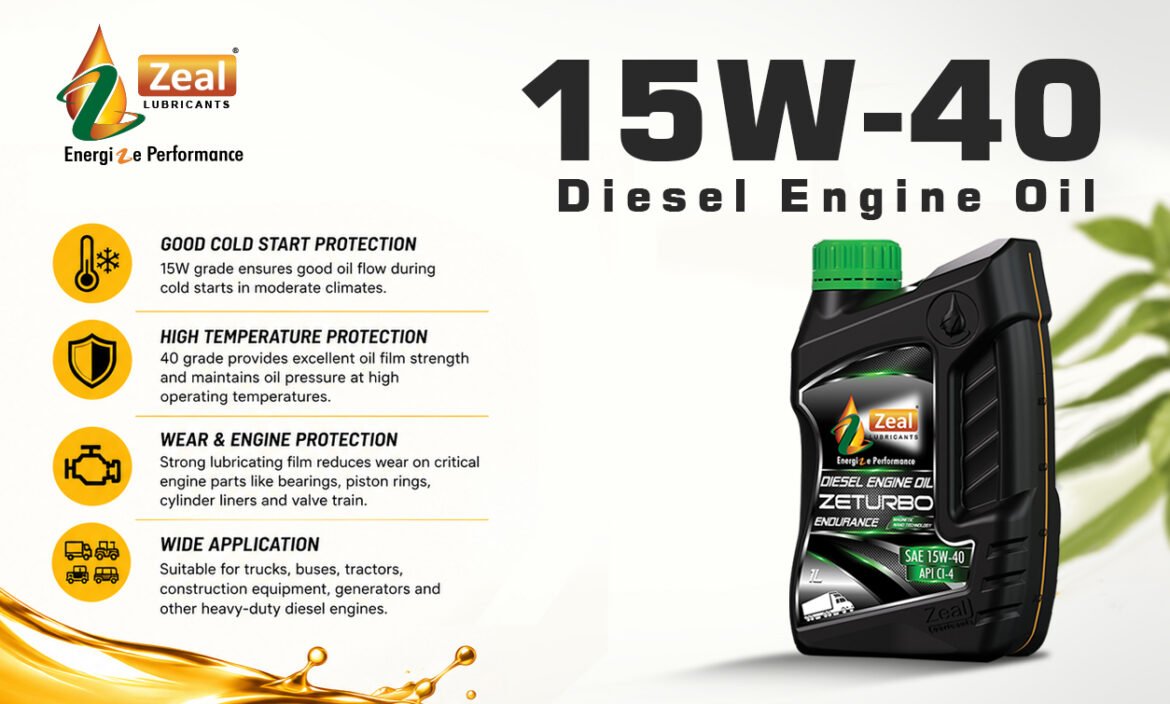
15W-40 diesel engine oil is the most popular grade because it offers the best balance between cold-start fluidity and high-temperature protection, making it suitable for a wide range of climates, heavy-duty applications, and engine designs. It is cost-effective, widely approved by OEMs, and minimizes maintenance downtime.
Why 15W-40 Is Most Popular?
1. Viscosity Balance
- 15W → Ensures good cold-start flow down to around -20°C, reducing wear during startup.
- 40 → Maintains strong film thickness at 100°C operating temperature, protecting bearings, pistons, and cylinder liners under heavy loads.
2. Heavy-Duty Diesel Suitability
- Designed for turbocharged, high-compression diesel engines that generate extreme heat and soot.
- Provides film strength under high pressure, preventing metal-to-metal contact.
3. Wide Application
- Used in long-haul trucks, buses, construction equipment, farm tractors, marine engines, and generators.
- Covers diverse climates, eliminating the need for seasonal oil changes.
4. OEM Approvals & Standards
- Meets API CK-4 (current heavy-duty diesel classification) and backward-compatible with CJ-4, CI-4.
- Approved by major manufacturers: Cummins, Detroit Diesel, Volvo, Mack, Renault, Mercedes-Benz, Ford.
5. Cost & Availability
- Cheaper than full synthetics while still offering reliable protection.
- Readily available worldwide, making it the default choice for fleets.
| Feature | 15W-40 Diesel Oil | Alternatives (e.g., 10W-30, Synthetic) |
| Cold-start protection | Good (-20°C) | Better in extreme cold (10W-30, 5W-40) |
| High-temp protection | Strong (40 grade) | Similar, but synthetics resist breakdown longer |
| Cost | Moderate, affordable | Higher (synthetics) |
| OEM approvals | Widely accepted | Limited depending on grade |
| Applications | Trucks, buses, tractors, generators | Specialized climates or extended drain intervals |
🚨 Risks & Trade-offs
- Cold climates (< -25°C): 15W-40 may be too thick; lighter grades (10W-30, 5W-40) are better.
- Extended drain intervals: Full synthetics outperform conventional 15W-40 in resisting oxidation and sludge.
- Fuel economy: Thinner oils (10W-30) can improve efficiency slightly, but at the cost of reduced film strength.