Why Is the UAE a Global Hub for the Oil and Gas Industry?
The United Arab Emirates (UAE) has developed into one of the world’s most important Oil and Gas Industry. Its position is built not only on large hydrocarbon reserves but also on decades of investment in production, refining, petrochemicals, storage, ports, logistics, trading, and supporting industries.
According to the U.S. Energy Information Administration (EIA), the UAE held an estimated 120 billion barrels of proven crude oil reserves in 2025 and produced about 3.8 million barrels per day of crude oil and condensate. It was also the ninth-largest producer of total liquid fuels globally in 2025. (U.S. Energy Information Administration)
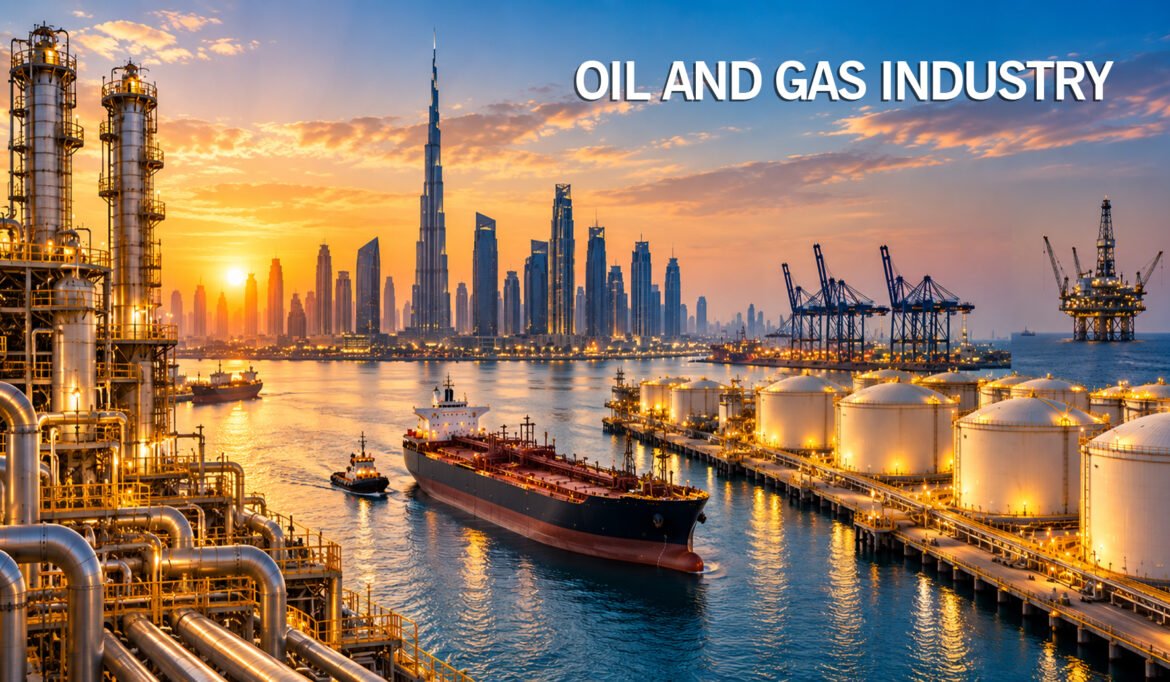
What makes the UAE particularly important, however, is the ecosystem surrounding these resources. Abu Dhabi serves as the country’s principal production centre, Ruwais has developed into a major downstream and industrial centre, Fujairah is an important storage and trading hub, while Dubai and Jebel Ali provide international logistics, petrochemical trading, storage and re-export capabilities.
1. Large Oil and Natural Gas Reserves
The most fundamental reason for the UAE’s position is its substantial resource base. EIA data based on OPEC’s 2026 statistical estimates puts UAE proven crude oil reserves at approximately 120 billion barrels in 2025. Proven natural gas reserves were estimated at approximately 297 trillion cubic feet. (U.S. Energy Information Administration)
These resources provide the foundation for long-term exploration, drilling and production activities. They have also encouraged the development of industries that support oil and gas operations, including engineering, chemicals, industrial lubricants, maintenance, transportation and specialised technical services.
Large reserves therefore create more than an upstream oil industry—they create demand throughout the energy supply chain.
2. High Oil Production Capacity
The UAE combines large reserves with significant production capability. Crude oil and condensate production reached approximately 3.8 million barrels per day in 2025, according to the EIA. The country is also working toward crude oil production capacity of 5 million barrels per day by 2027. (U.S. Energy Information Administration)
ADNOC currently reports oil production capacity of around 4.85 million barrels per day and natural gas capacity of approximately 11.5 billion cubic feet per day. (ADNOC)
High production volumes generate continuous requirements for drilling, processing, transportation, storage, maintenance and industrial consumables. This creates opportunities for a broad range of supporting companies.
3. Abu Dhabi as the Upstream Energy Centre
Oil and gas activity within the UAE is heavily centred on Abu Dhabi, where ADNOC and its operating businesses have developed a large upstream and downstream industrial network.
The resulting concentration has attracted international energy companies, drilling contractors, EPC companies, oilfield-service providers, chemical suppliers and equipment manufacturers.
This clustering produces an important commercial advantage: companies operating within the sector can access customers, suppliers, infrastructure and specialist services within a relatively concentrated geographical area.
In economic terms, this is a classic industrial cluster effect.
4. A Complete Oil and Gas Value Chain
One of the UAE’s greatest advantages is that its energy industry is not restricted to exporting crude oil.
The country has developed capabilities across much of the value chain:
Exploration → Drilling → Production → Gas Processing → Pipelines → Refining → Petrochemicals → Storage → Trading → Marine Services → Distribution → Export
The existence of this integrated infrastructure allows value to be created at several stages instead of relying solely on upstream production.
It also explains why many companies involved in petrochemicals, base oils, lubricants, additives, industrial chemicals, marine products and specialty fluids choose the UAE as a regional operating base.
5. Strategic Location Between Asia, Europe and Africa
Geography is another major competitive advantage of Oil and Gas Industry in UAE.
The UAE lies close to some of the world’s largest hydrocarbon-producing countries while also providing efficient maritime access to major consuming markets across:
- South Asia
- East Asia
- Africa
- Europe
- the wider Middle East
This makes the country attractive not only for production but also for storage, commodity trading, distribution and re-export.
Jafza specifically identifies its location at the crossroads of Asia, Africa and Europe as a major factor supporting its petrochemical industry. (Jebel Ali Free Zone (Jafza))
For an international energy company, therefore, a UAE operation can function as a regional headquarters or distribution platform rather than merely serving the relatively small domestic market.
6. Fujairah: A Major Oil Storage and Trading Hub
Fujairah plays a different but highly complementary role to Abu Dhabi.
Its location on major international oil routes, together with deep-water port infrastructure and extensive tank farms, has transformed the emirate into an important centre for oil storage, trading and marine fuel activities.
The Fujairah Oil Industry Zone (FOIZ) reports approximately 70 million barrels of storage capacity for different types of oil products and describes Fujairah as a critical Middle Eastern oil trading and storage hub. (Foiz)
This creates an important division of strengths within the UAE:
Abu Dhabi → Production and upstream
Ruwais → Refining, gas and downstream industry
Fujairah → Storage, trading and bunkering
Dubai/Jebel Ali → Trading, logistics, petrochemicals and re-export
Together, these locations form a much broader energy ecosystem than any single oil-producing region could provide.
7. Jebel Ali’s Petrochemical and Logistics Ecosystem
Dubai’s Jebel Ali Port and Jebel Ali Free Zone (Jafza) provide another major advantage.
DP World reports that the Jebel Ali petrochemical hub has tank terminals with 11 dedicated liquid-handling berths, more than 1 million cubic metres of liquid-bulk storage space, and specialised facilities for chemicals, fuels and lubricants. (Jebel Ali Free Zone (Jafza))
The ecosystem extends beyond storage. Jebel Ali provides capabilities covering chemical blending, warehousing, packaging, labelling, inventory management, customs clearance, freight forwarding, transportation and ISO tank services. (Jebel Ali Free Zone (Jafza))
This is particularly valuable to companies that need to import raw materials and redistribute finished products internationally.
For example, a lubricant manufacturer can potentially use the UAE ecosystem to:
Import base oils & additives → store raw materials → blend lubricants → package products → warehouse finished goods → export through Jebel Ali
That integrated infrastructure reduces the complexity of international distribution.
8. Strong Petrochemical and Chemical Industry
Oil and natural gas also provide feedstocks for downstream manufacturing.
Petrochemicals are important because they connect the energy industry with plastics, packaging, automotive products, construction materials, industrial chemicals and many other manufacturing sectors.
Jafza has developed a particularly significant petrochemical cluster. A 2024 DP World announcement reported more than 840 petrochemical companies from over 82 countries operating in Jafza at that time. (Jebel Ali Free Zone (Jafza))
This concentration creates a network effect. When hundreds of manufacturers, traders, distributors, logistics providers and service companies operate within the same ecosystem, it becomes progressively easier for new companies to source products, identify customers and establish supply-chain relationships.
9. Continuous Investment in Energy Infrastructure
The UAE has continued investing in hydrocarbons rather than treating its existing infrastructure as complete.
The EIA notes that since 2018 the UAE has invested heavily in expanding hydrocarbon production capacity and developing additional midstream and downstream infrastructure. (U.S. Energy Information Administration)
ADNOC’s growth strategy also targets oil production capacity of 5 million barrels per day by 2027. (ADNOC)
The investment is also extending into LNG. The Ruwais LNG project under development is designed for 9.6 million tonnes per annum of LNG production capacity and is scheduled to begin commercial operations in 2028. (ADNOC)
This continuing investment helps maintain demand for contractors, equipment, industrial fluids, chemicals and supporting services.
10. Strong Supporting Industries
An oil and gas hub requires much more than oil companies. The UAE has consequently developed supporting sectors including:
Oilfield services | EPC & engineering | Marine services | Tank storage | Shipping | Petrochemicals | Industrial chemicals | Base oils | Lubricants | Greases | Additives | Equipment | Maintenance | Packaging | Warehousing | Testing & laboratories | Freight forwarding
This supporting network is one of the reasons an established energy cluster becomes difficult for competitors to replicate.
A company entering the UAE does not necessarily have to build an entire supply chain independently—it can access many specialist services already operating within the market.
11. A Major Trading and Re-Export Platform
Another important distinction is that the UAE’s energy importance is not determined solely by the amount of oil it produces.
Dubai and Fujairah have developed substantial capabilities in the movement and redistribution of energy products.
Jebel Ali, for example, offers specialised storage for packed lubricants, fuels and industrial chemicals, along with ISO-tank storage, hazardous-goods warehousing, blending, packaging and freight-forwarding services. (Jebel Ali Free Zone (Jafza))
Fujairah provides large-scale hydrocarbon storage and access to major international maritime oil routes. (Foiz)
The combination allows the UAE to function as a bridge between producers, traders, manufacturers and end users across multiple regions.
UAE Oil & Gas Hub – Research Summary
| Key Advantage | Why It Matters | Major UAE Location |
| 120 billion barrels of proven crude reserves | Provides a large long-term upstream resource base | Abu Dhabi |
| 297 Tcf natural gas reserves | Supports gas processing, industry and future LNG development | Abu Dhabi / Ruwais |
| High production capacity | Creates large-scale demand for oilfield equipment, services and consumables | Abu Dhabi |
| Integrated value chain | Connects production with refining, petrochemicals, storage and exports | Abu Dhabi / Ruwais |
| Strategic geographical position | Connects Middle East supply with Asia, Africa and Europe | UAE |
| Major ports | Supports efficient bulk imports and exports | Jebel Ali / Fujairah |
| Large oil storage capacity | Makes the country attractive for international oil trading | Fujairah |
| Petrochemical infrastructure | Supports chemicals, polymers, base oils and related industries | Jebel Ali / Ruwais |
| Free-zone ecosystem | Supports international trading, logistics and regional distribution | Jafza |
| Advanced logistics | Warehousing, ISO tanks, liquid terminals and freight services support energy trade | Dubai / Fujairah |
| International connectivity | Allows companies to serve several continents from one regional base | Dubai / Fujairah |
| Continuous investment | Expands future production and downstream capacity | Abu Dhabi / Ruwais |
| Supporting industries | Creates a mature network of engineering, chemicals, lubricants and technical services | UAE-wide |
| Re-export capability | Allows imported products and raw materials to be redistributed internationally | Dubai / Fujairah |
Why This Matters for the Lubricants Industry
The same factors that make the UAE a major oil and gas hub also make it a strategically attractive location for the Oil and Gas Industry.
Lubricant manufacturers require reliable access to base oils, additives, packaging, storage tanks, laboratories, blending facilities, ports, warehouses and international transportation. The UAE’s established petroleum and petrochemical supply chain provides many of these supporting capabilities.
At the same time, the surrounding economy generates lubricant demand from passenger vehicles, commercial fleets, construction equipment, oilfield machinery, manufacturing plants, power generation, marine vessels and other industrial applications.
Jebel Ali’s infrastructure is particularly relevant: DP World specifically identifies facilities for packed lubricants, fuels and industrial chemicals alongside liquid storage and blending services. (Jebel Ali Free Zone (Jafza))
This combination of supply-chain access + domestic industrial demand + export connectivity helps explain why the UAE has also become an attractive base for lubricant manufacturers, suppliers and distributors serving the Middle East, Africa and international markets.
Conclusion
The UAE became a global Oil and Gas Industry because it transformed a natural-resource advantage into a much broader energy, manufacturing, logistics and trading ecosystem.
Its competitive position can be summarized as:
Large Reserves + High Production Capacity + ADNOC + Refining + Petrochemicals + Storage + World-Class Ports + Strategic Location + Trading + Logistics + Supporting Industries + International Connectivity
Abu Dhabi provides the hydrocarbon resource and production base; Ruwais strengthens refining, gas and downstream activities; Fujairah provides major storage and oil-trading infrastructure; and Dubai/Jebel Ali connects the sector to global logistics, petrochemicals and re-export markets.
As a result, the UAE’s importance to the global energy industry is no longer based simply on how much oil lies beneath the ground. Its greater advantage is the sophisticated industrial ecosystem that has been built around those resources. (U.S. Energy Information Administration)